Getting Married in Bristol or Bath This Summer? Your Wasp-Proofing Checklist
Planning an outdoor wedding in Bristol or Bath this summer? Here's your wasp-proofing checklist, plus same-day emergency cover if a nest turns up on the day.
Quick Answer: Wasps peak in July, August, and September — precisely when most outdoor weddings happen. To protect your day, ask your venue to inspect all outbuildings, roof spaces, and boundary hedgerows for active nests at least four weeks before the wedding.
Remove or cover all open food and drink stations during gaps in service. Avoid floral perfumes and highly scented products on the wedding party. And if a nest is discovered on the morning of your wedding, call a BPCA-accredited pest controller — a professional treatment takes under an hour, and the treated nest will be silent within two.
You've confirmed the venue. You've chosen the caterers. You've agonised over the seating plan. The one thing that doesn't appear on most wedding planning checklists — and really should — is wasps.
This isn't a minor inconvenience risk. A mature wasp colony by mid-August can contain upwards of 5,000 workers. A nest in the eaves of a barn, in the hedgerow bordering a marquee, or beneath the decking of a terrace drinks reception is capable of disrupting proceedings in a way that no amount of backup planning fully covers.
Guests with allergies face a genuine medical risk. Everyone else faces a memorable afternoon for entirely the wrong reasons.
The good news is that wasp problems at outdoor events are almost entirely preventable — if you know what to look for and when to look for it. Here's the checklist.
Why Outdoor Summer Weddings Attract Wasps
Understanding what draws wasps to wedding settings makes it easier to mitigate the risk.
The timing. Wasp colonies grow throughout summer. A queen starts a nest the size of a golf ball in April. By July the colony has hundreds of workers; by August, thousands.
Peak wasp activity in the Bristol and Bath area falls squarely across the most popular wedding months. The 2026 season is tracking earlier than usual following the mild winter — which means peak numbers may arrive in July rather than August.
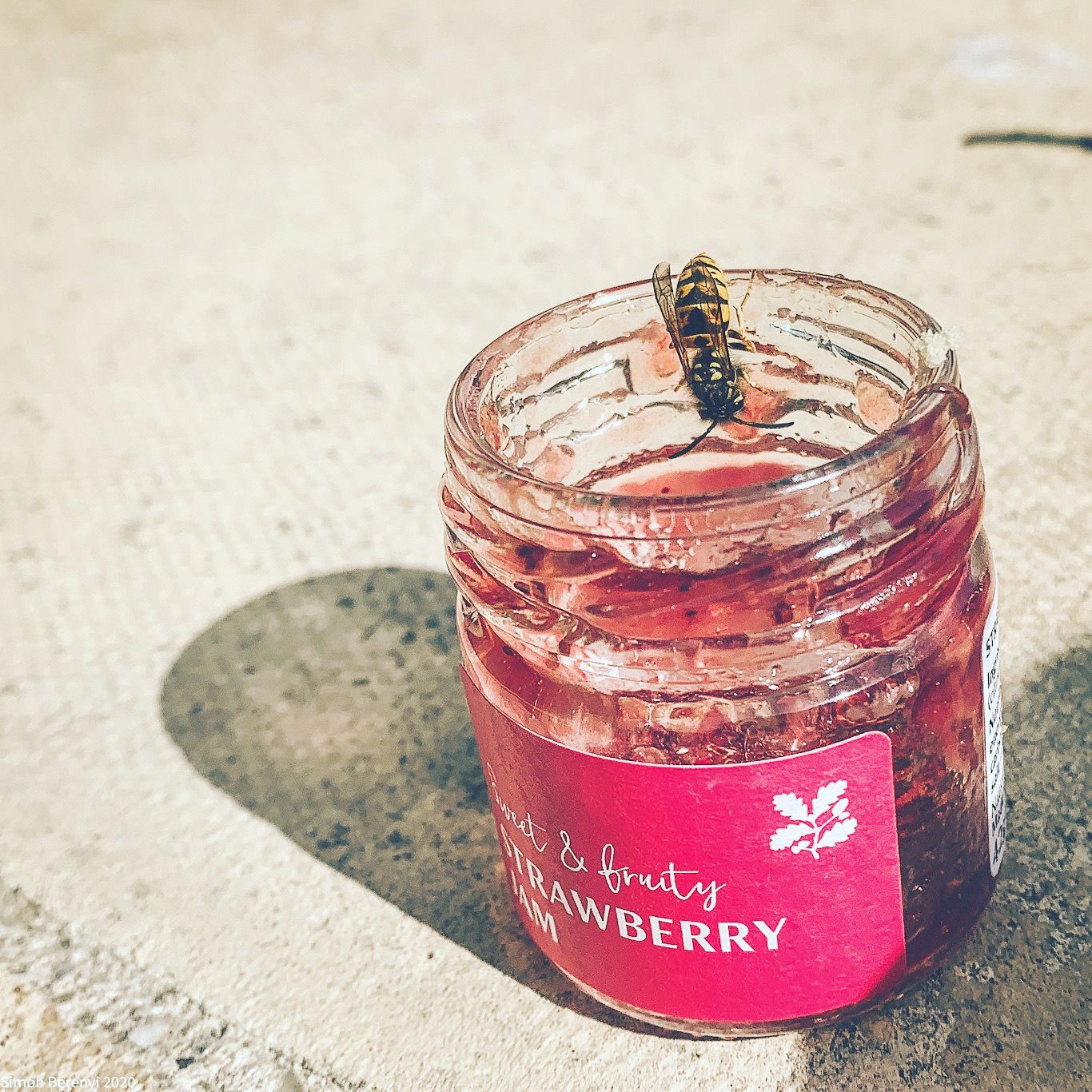
The food. Wasps are opportunistic foragers, and summer receptions offer an extraordinary concentration of exactly what they want: sweet drinks, fruit, sugary puddings, and protein from meat canapés and buffet dishes. An outdoor drinks reception or alfresco wedding breakfast is, from a wasp's perspective, an exceptional foraging event. Open prosecco glasses, uncovered fruit bowls, and platters left out between courses are the primary attractants.
The setting. Most beautiful outdoor wedding venues in our area — Ashton Court, Folly Farm, Arnos Vale, Priston Mill, the gardens of Parade Gardens in Bath, the Chew Valley estates — are set in exactly the kind of mature, mixed environment that wasps favour for nesting. Old stone walls, established hedgerows, veteran trees, period outbuildings with accessible roof voids: all are ideal nesting habitat. The aesthetic appeal of these venues and the wasp habitat they provide are essentially the same thing.
The heat. Warm days increase wasp activity and — critically — increase aggression in late-season colonies. A colony in August or September is producing fewer larvae and more workers, workers who are no longer focused on feeding young and are instead sugar-seeking and more easily agitated. This behavioural shift is exactly why late-summer wasps seem more belligerent than earlier in the year: they are.
What to Check at Your Venue Beforehand
This inspection should ideally happen four to six weeks before the wedding date, with a follow-up check a week before. It gives enough lead time to treat any nests found before they reach peak size, and time to re-check that treatment has been effective.
Ask the venue directly — and get a specific answer. Most venues are well-intentioned but general in their responses. "We haven't had any complaints" is not the same as "we've inspected the grounds." Ask specifically: when were the outbuildings last checked for wasp nests? Has anyone inspected the roof void above the barn / the eaves of the ceremony structure / the hedgerows bordering the marquee area? You want dates and specifics, not reassurances.
Walk the site with a purpose. On your final venue visit, take fifteen minutes to do a slow perimeter walk. Look for wasps flying with purpose — not foraging randomly, but making consistent straight-line flights in and out of the same point. That directed flight pattern is a reliable indicator of a nest entrance.
Common locations to check:
- Eaves and soffits of any outbuilding, barn, or ceremony structure
- Air bricks and gaps in older stone or brick walls
- Ground-level entrances in lawns, banks, or soft soil near hedgerows — particularly on south-facing slopes that warm early
- Dense hedge bases and compost areas
- Any stored furniture, equipment, or marquee infrastructure that has been undisturbed since last summer
Check the specific ceremony and reception footprint. The nest that matters most is the one within 30–50 metres of where guests will be eating and drinking. A nest 200 metres away in a distant corner of the estate is a much lower risk than one in the wall cavity adjacent to the marquee entrance.
Book a pre-wedding professional inspection if in doubt. If the venue is set in particularly mature grounds, involves older buildings, or the coordinator can't give you a definitive answer on nest status, a professional inspection is worth arranging. It takes an hour, costs far less than a catering upgrade, and gives you a reliable answer rather than a hopeful assumption
.
Same-Day Emergency Cover for Wedding Day
Even with thorough preparation, wasps can establish new nests quickly, and a colony that wasn't visible six weeks ago may be active and significant by the wedding day. Here's what to do if a nest is found on the morning.
Don't panic — and don't attempt DIY treatment. A tin of supermarket wasp spray applied by a well-meaning groundskeeper at 7am will agitate the colony, not eliminate it, and leave an angry nest in exactly the location you're trying to protect. Professional treatment is the only approach that works reliably, and it works quickly.
Call early in the morning, not when guests are arriving. A professional pest controller attending a same-day job for a nest in a non-residential building can typically treat and be off-site within 45–60 minutes. The nest will fall silent progressively over the following hour to two hours as workers return and are affected by the treatment. A call placed at 8am leaves time to treat before the ceremony starts. A call placed at 1pm, when guests are already arriving, does not.
Keep guests away from the area between call and treatment. Brief your venue coordinator and the relevant member of the events team on the location of the nest and establish a clear exclusion zone. This doesn't need to be dramatic — a simple instruction to direct people away from a specific wall or corner is sufficient. What matters is that no one is in close proximity to an active nest entrance in the period before treatment.
Have a contact saved in your phone before the day. The worst time to search for an emergency pest controller is at 8am on your wedding morning when you're simultaneously managing hair and make-up, a nervous wedding party, and a venue coordinator. Save the number in advance.
Pale Horse Pest Control covers Bristol, Bath, and the surrounding area with same-day emergency response throughout wasp season. We're BPCA-accredited, experienced with event and venue jobs, and understand what it means to work quietly and quickly in a setting where discretion matters. We attend loft voids, barn eaves, garden ground nests, and hedgerow colonies — wherever the problem is, we can reach it.
Call us on 0117 369 9909 or get in touch via our contact page to save our details before your wedding day. If you'd like a pre-wedding site inspection arranged, we're happy to liaise directly with your venue coordinator.
One final note for guests as much as couples: if you're attending an outdoor wedding this summer and a wasp starts circling, the best thing you can do is stay calm and move away slowly. Don't swat. Don't flail. Don't pour your drink over it. The wasp is not interested in you — it's interested in your glass of Pimm's, and you can let it have a moment of investigation without incident far more easily than the alternative.
Enjoy the day. We'll handle the rest.
Pale Horse Pest Control serves Bristol, Bath, and the surrounding area. BPCA-accredited wasp nest removal with same-day emergency cover available throughout summer.
Call 0117 369 9909 or visit
palehorsepestcontrol.uk.